Jupiterswap: Solana token swaps and execution choices
Jupiterswap aggregates Solana liquidity through Jupiter, comparing available routes and market-maker quotes for token swaps. The selected token pair, trade size, and execution settings determine the offer. Immediate swaps exchange tokens at an available market quote. Price-triggered and recurring orders add conditions or scheduling, with funding arrangements that differ from an immediate wallet swap.
A quoted output amount describes proposed execution. The tokens ultimately received also reflect the route's execution conditions and applicable fees. Price impact, slippage tolerance, and transaction status explain different parts of that exchange.
Automatic Jupiter gas sponsorship pays network costs in SOL and recovers their value through the swap fee.
Where does a Jupiter swap quote come from?
For a chosen token pair and input amount, Jupiter compares quotes from the routing engines available to that request. Metis searches on-chain liquidity, with routes that can split a trade across pools or use intermediate tokens. JupiterZ obtains market-maker offers through a request-for-quote system, or RFQ. The Swap API V2 Meta-Aggregator also includes DFlow and OKX among its routing engines.
The integration determines which engines can compete. The Meta-Aggregator compares these sources, while the API's Router path uses Metis only; excluding an engine narrows the available choices. A quote describes the liquidity available for the selected amount; changing that amount can change both the route and the exchange rate. Aggregation does not make every Solana market eligible for every request.
Price impact and slippage describe different changes
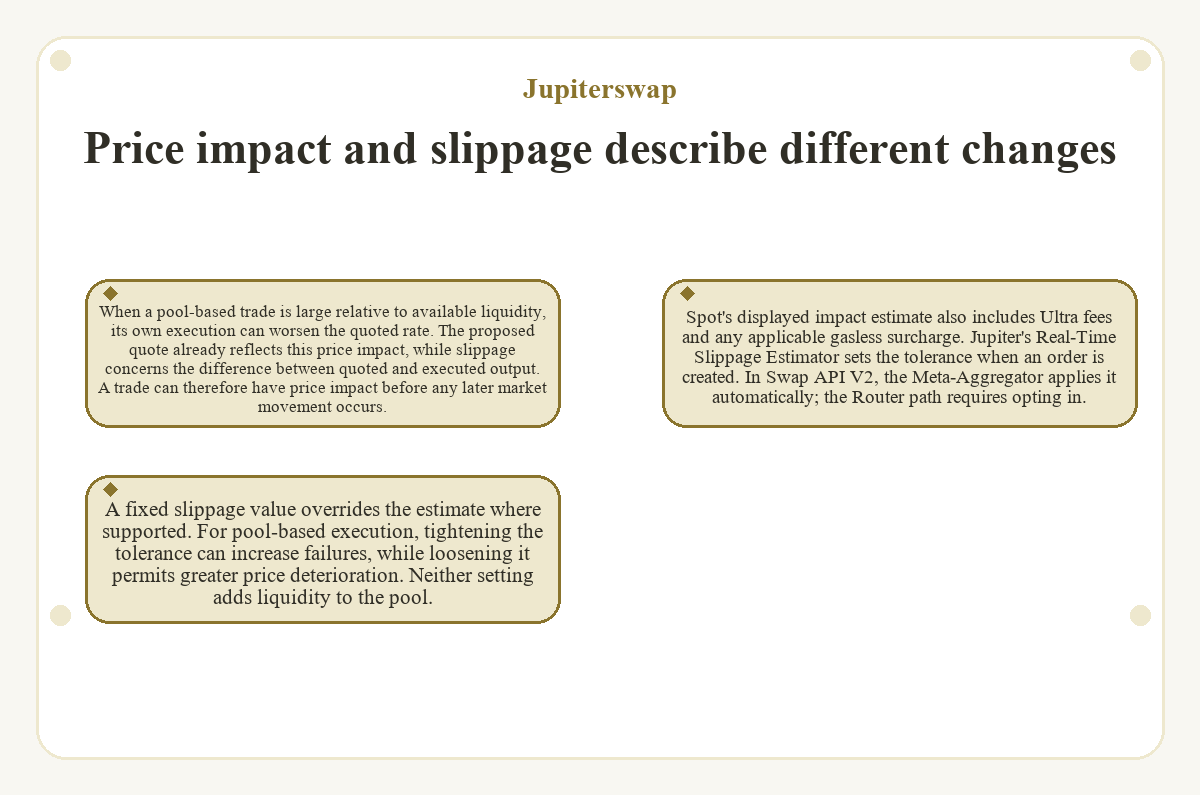
When a pool-based trade is large relative to available liquidity, its own execution can worsen the quoted rate. The proposed quote already reflects this price impact, while slippage concerns the difference between quoted and executed output. A trade can therefore have price impact before any later market movement occurs. Spot's displayed impact estimate also includes Ultra fees and any applicable gasless surcharge.
Jupiter's Real-Time Slippage Estimator sets the tolerance when an order is created. In Swap API V2, the Meta-Aggregator applies it automatically; the Router path requires opting in. A fixed slippage value overrides the estimate where supported. For pool-based execution, tightening the tolerance can increase failures, while loosening it permits greater price deterioration. Neither setting adds liquidity to the pool.
What costs can affect the tokens you receive?
Route fees, Jupiter's applicable commission, integrator charges, and account or network costs can affect the exchange's total cost. Spot's Ultra platform-fee schedule lists rates from 0% to 0.5%, depending on the pair. Manual market swaps have no Jupiter commission, although pool and network costs still matter. Native Jupiter Mobile swaps follow a separate fee schedule. Token-account creation can also require a SOL deposit for account storage.
Automatic Jupiter gas sponsorship recovers the gas expense through the swap fee. In Spot, it requires a verified sell-side token, less than 0.01 SOL in the wallet, and a sufficient trade size. The indicative trade threshold is about $10 and varies with network fees; gas recovery must stay within 10% of the trade value. JupiterZ market makers can instead pay signature and priority fees directly. For JupiterZ orders in Swap API V2, output-account rent is separate from the network fees that the market maker pays: Jupiter can sponsor it without referral fees, while referral-enabled JupiterZ orders require the taker to cover that rent. Gasless describes who supplies the network-fee payment.
Token identity and the meaning of safety indicators
A Solana mint address identifies the actual token involved in an exchange. Names and tickers can repeat across unrelated tokens, so a matching label does not establish identity. A token account records ownership for a particular mint.
Spot displays token permissions and market indicators alongside its trading tools. A mint authority can create additional supply. A freeze authority can freeze token accounts, blocking transfers. Holder concentration and organic activity describe other aspects of the market. Favorable readings do not establish that liquidity will remain available or that the token's controllers will leave its permissions unchanged.
Liquidity can disappear when its providers withdraw the assets that support trading.
Market swaps, price triggers, and recurring orders
For a trade governed by a price target or schedule, Jupiter offers automated orders alongside immediate swaps. Trigger V2 supports USD-price conditions, take-profit and stop-loss orders, and linked orders. Reaching a trigger starts execution at the available market rate. It does not lock the output estimate shown when the order was created, and liquidity or slippage can prevent a fill.
An OCO, or One-Cancels-Other, arrangement links take-profit and stop-loss orders to the same deposit; when one fills, the other cancels. OTOCO means One-Triggers-One-Cancels-Other: a parent order fills before its linked take-profit and stop-loss pair becomes active.
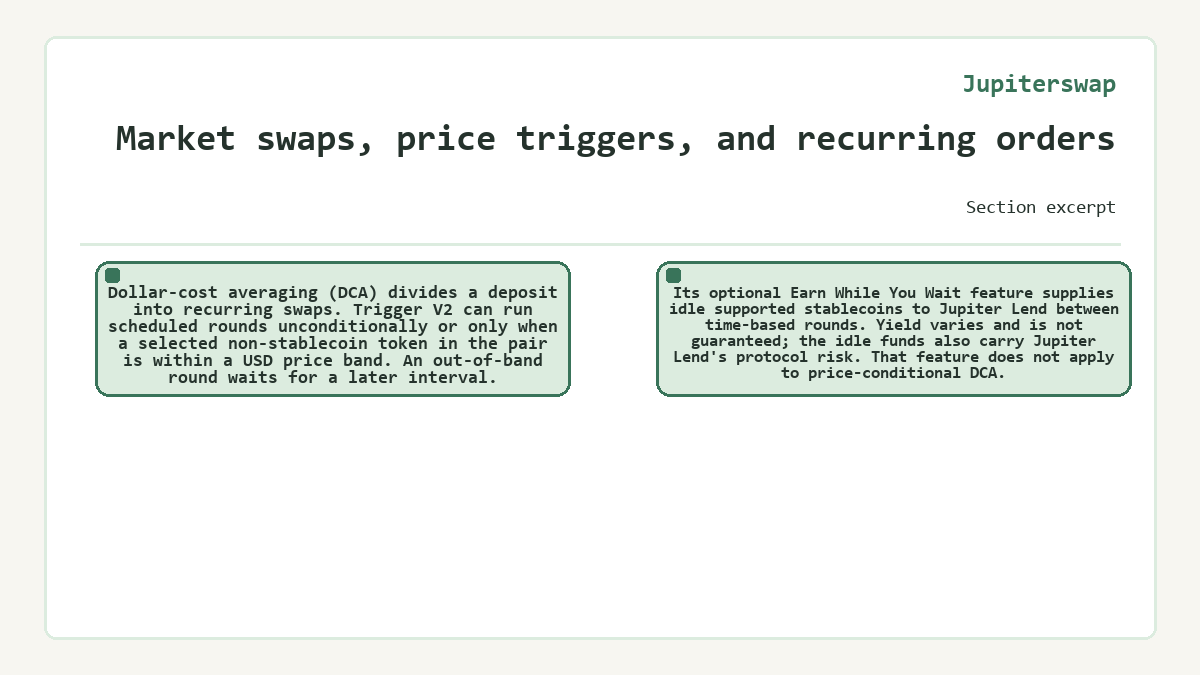
Dollar-cost averaging (DCA) divides a deposit into recurring swaps. Trigger V2 can run scheduled rounds unconditionally or only when a selected non-stablecoin token in the pair is within a USD price band. An out-of-band round waits for a later interval. Its optional Earn While You Wait feature supplies idle supported stablecoins to Jupiter Lend between time-based rounds. Yield varies and is not guaranteed; the idle funds also carry Jupiter Lend's protocol risk. That feature does not apply to price-conditional DCA.
Trigger V2 holds deposited order funds in Privy-managed custodial vault accounts. This funding arrangement differs from an immediate swap signed by a wallet. Trigger V1 uses on-chain order accounts and receives only critical updates. The legacy Recurring V1 API has been superseded and is no longer actively maintained. Spot no longer accepts new DCA V1 orders; existing ones remain viewable and cancellable.
Access through Spot, mobile, and integrations
Jupiter Spot combines token swaps with discovery tools, charts, and portfolio activity. Ultra execution manages trade settings and transaction delivery, while Manual Mode exposes configurable settings. Ultra also uses private submission to reduce front-running and sandwich attacks, although that protection does not eliminate the risk. Manual swaps lack Ultra's built-in MEV protection and receive no Jupiter refunds or execution support. Classic layout uses Ultra only; Trench layout also exposes manual presets. Access can use a compatible Solana wallet or a Jupiter Quick Account, an embedded wallet with email or social sign-in. Quick Accounts support trading without a separate approval for every transaction.
Jupiter Mobile executes native market swaps through Ultra. Applications can embed Jupiter Plugin or integrate Swap API V2. Its Meta-Aggregator returns an assembled transaction for managed delivery. The Router path returns Metis swap instructions for a custom transaction. Developers can combine those instructions with other on-chain actions, while retaining responsibility for constructing and submitting the transaction. The interface that hosts a swap can also affect the available controls and integrator fees.
Quick Accounts are noncustodial wallets; Trigger V2 holds deposited order funds in separate custodial vaults.
Interpreting a quote before authorizing the swap
When the question is how much an immediate swap will deliver, expected output and minimum output answer different questions. The quote estimates the exchange, while a pool-based route's minimum-output threshold limits acceptable deterioration. The settings must describe the same intended trade:
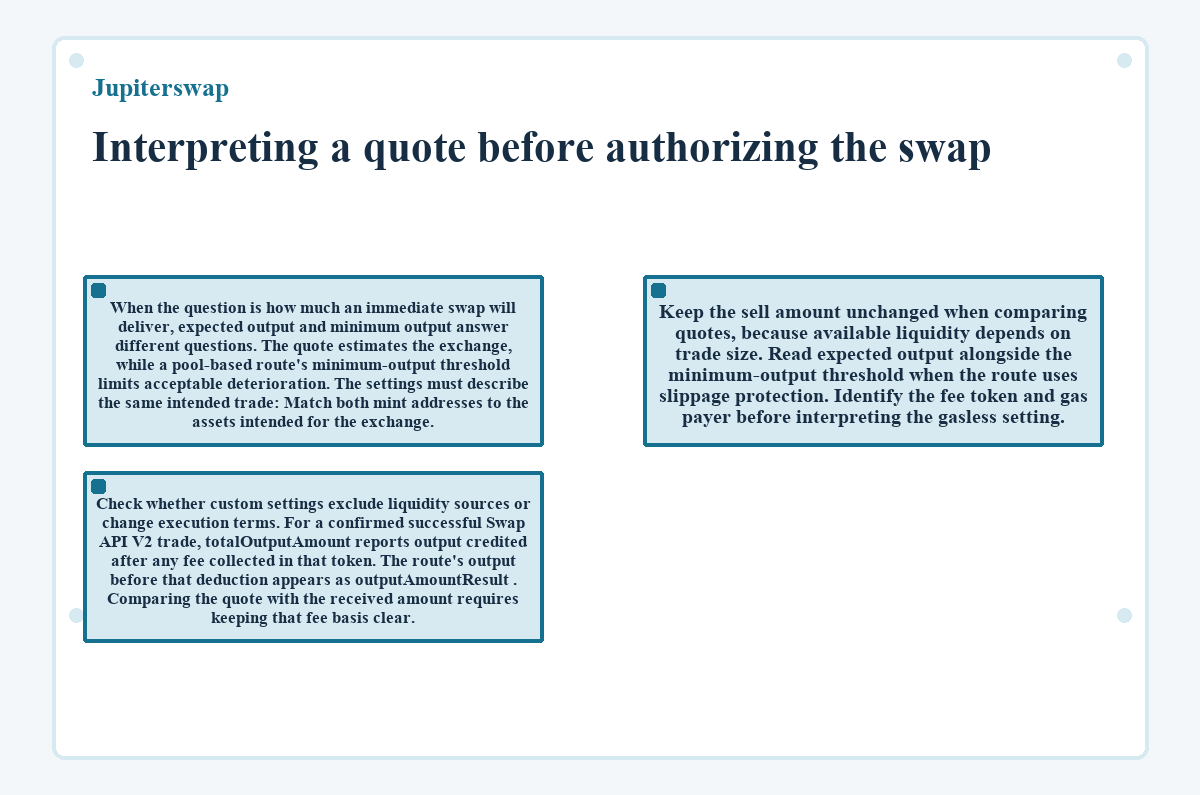
- Match both mint addresses to the assets intended for the exchange.
- Keep the sell amount unchanged when comparing quotes, because available liquidity depends on trade size.
- Read expected output alongside the minimum-output threshold when the route uses slippage protection.
- Identify the fee token and gas payer before interpreting the gasless setting.
- Check whether custom settings exclude liquidity sources or change execution terms.
For a confirmed successful Swap API V2 trade, totalOutputAmount reports output credited after any fee collected in that token. The route's output before that deduction appears as outputAmountResult. Comparing the quote with the received amount requires keeping that fee basis clear.
Jupiterswap FAQs
-
How long can a Jupiter swap quote remain valid?
- Quote validity depends on the execution route and the expiry information returned with the order. In Swap API V2, aggregator transactions expire after their lastValidBlockHeight, while JupiterZ quotes carry a market-maker expiry timestamp called expireAt. Prices can move before either limit, so an unexpired quote can still fail its execution conditions.
-
Why can a selected token pair return 'no routes found'?
- Jupiter returns this message when it cannot find an executable route for the selected request. Causes include insufficient pair liquidity, a trade amount outside what available routes can handle, or token trading restrictions. A token's appearance in search does not ensure that liquidity exists for that particular exchange and size.
-
Can a recurring order be paused without cancelling it?
- Jupiter recurring orders do not support pausing and resuming. Stopping the schedule requires cancellation, and restarting requires a new order. For Trigger V2 DCA, cancellation returns the unfilled remainder to the wallet; it does not reverse completed rounds. The new order has its own schedule and execution conditions.
-
Does wrapped SOL pay network fees like native SOL?
- Wrapped SOL cannot pay Solana transaction fees, which require native SOL unless another payer covers them. Jupiter normally handles wrapping and unwrapping during swaps, so ordinary swaps to SOL deliver native SOL. For swaps into SOL, the Use wSOL routing setting in Manual Mode changes delivery to wrapped SOL for tasks that require its token form.
-
Are network fees charged when an on-chain swap fails?
- A Solana transaction that executes and fails still incurs its network processing fee. That differs from a quote that never becomes an on-chain transaction. An on-chain slippage rejection can cancel the exchange without refunding the processing fee. On gas-sponsored routes, the fee payer may be Jupiter, a market maker, or the integrating application.
Last updated -